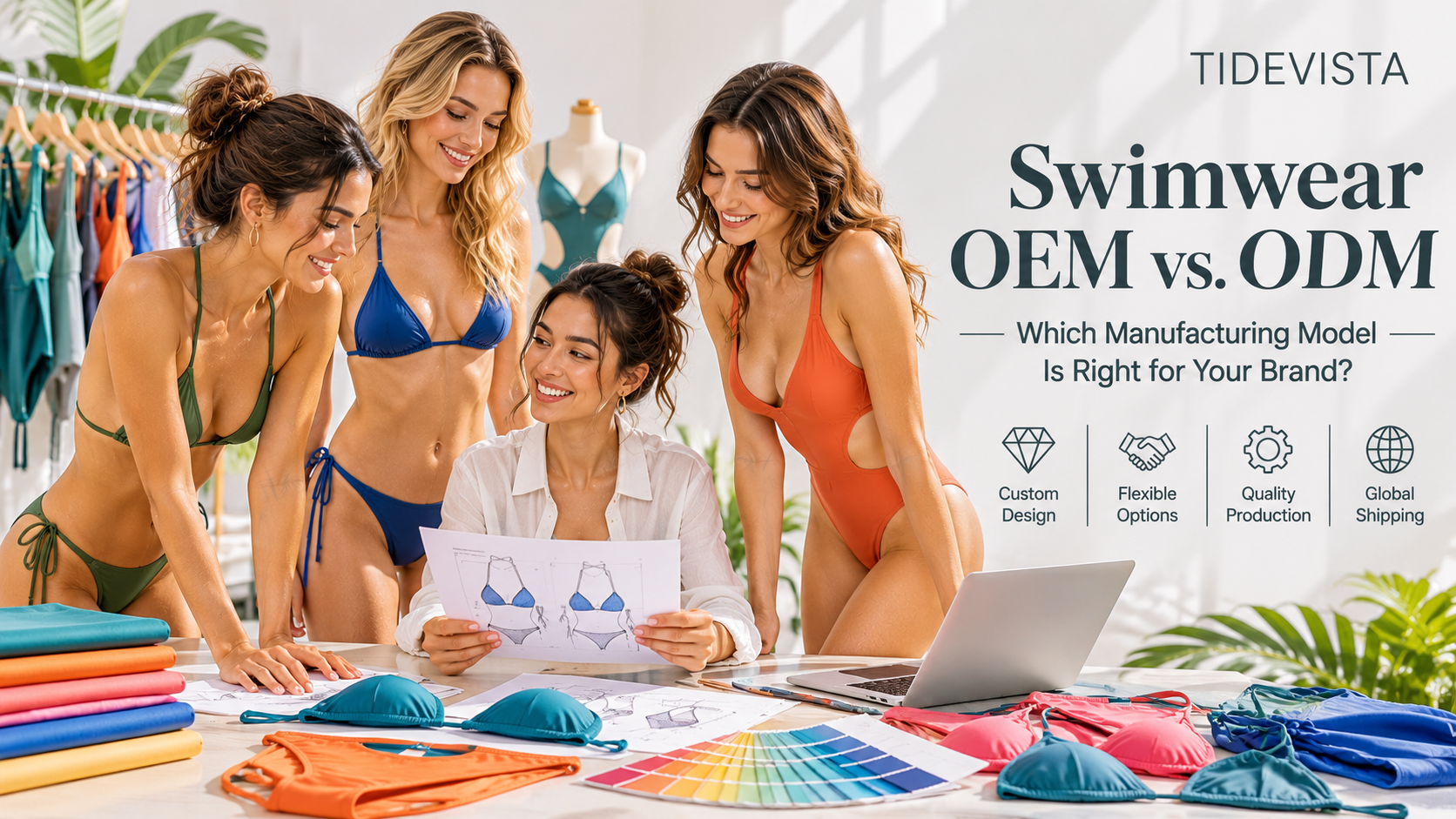
Swimwear OEM vs. ODM: Which Manufacturing Model Is Right for Your Brand?
If you are planning to launch a swimwear brand, choosing the right manufacturing model is an important step. Two common options are OEM and ODM manufacturing. Both can help businesses develop swimwear products, but they differ in how designs are created, how much customization is involved, and how buyers work with suppliers.
Understanding swimwear OEM vs. ODM can help you select a suitable production approach, manage your development budget, and prepare for a successful product launch.
Whether you are building a new bikini brand, expanding an existing swimwear collection, or sourcing private label swimsuits for retail, this guide explains the key differences and what to consider before choosing a manufacturing partner.
1. What Is OEM Swimwear Manufacturing?
OEM stands for Original Equipment Manufacturing. In swimwear production, OEM generally refers to a model in which the buyer provides the design or product specifications and the manufacturer produces the garments according to the agreed requirements.
Depending on the supplier's capabilities, an OEM project may involve custom bikinis, one-piece swimsuits, tankinis, and other swimwear products.
How OEM Swimwear Works
The buyer usually provides some or all of the following:
Design sketches or reference images
Technical packs and garment measurements
Fabric and color specifications
Construction and finishing requirements
Logo placement and branding instructions
Packaging requirements
The manufacturer reviews the specifications, develops samples where required, and produces the garments according to the approved agreement.
Benefits of OEM Swimwear
Greater design control: Buyers can define the silhouette, measurements, colors, and construction details.
Brand differentiation: Custom designs can help a brand establish a more distinctive product identity.
Specification control: Detailed product requirements make it easier to communicate the intended fit, appearance, and quality standards.
Product development flexibility: Depending on the supplier, buyers may be able to modify existing designs or develop products from their own concepts.
OEM can be suitable for established brands with their own design direction, as well as new businesses that have clear product ideas and are ready to develop samples.
However, fully customized products may require more development work, sampling, and material coordination than standard products.
2. What Is ODM Swimwear Manufacturing?
ODM stands for Original Design Manufacturing. In a typical ODM arrangement, the manufacturer offers existing designs or develops product designs that buyers can select and customize according to the supplier's available services.
This model can be useful for businesses that want to launch a collection without developing every garment entirely from scratch.
How ODM Swimwear Works
An ODM project may follow these steps:
Review the manufacturer's available swimwear styles.
Select suitable bikinis, one-piece swimsuits, or other products.
Choose available fabrics and colors.
Discuss permitted changes to product details.
Add branding and packaging where supported.
Confirm samples, specifications, order quantities, and production terms.
The exact options depend on the manufacturer's catalog and customization policies.
Some suppliers may allow adjustments to colors, straps, labels, or packaging, while more substantial changes may require additional development.
Benefits of ODM Swimwear
A more accessible starting point: Buyers can begin with existing product designs rather than creating every style from the beginning.
Potentially simpler development: Using an established design may reduce some pattern-development work.
Faster product planning: Selecting from available styles can help simplify the initial collection-development process.
Convenient product selection: Buyers can compare multiple designs before choosing a collection direction.
ODM may be suitable for startups, online retailers, boutique brands, and businesses testing demand before investing in extensive custom development.
However, an existing design does not automatically guarantee a lower MOQ, lower unit price, or shorter lead time. These details must be confirmed with the supplier.
3. Swimwear OEM vs. ODM: Key Differences
Although both models involve working with a manufacturer, their main differences relate to design responsibility, customization, and development requirements.
Design Responsibility
With OEM, the buyer generally provides the design or detailed product specifications.
With ODM, the manufacturer generally offers an existing design or a design developed through its own product-development process.
Customization Options
OEM may allow extensive customization when the manufacturer supports the requested materials, construction, and specifications.
ODM typically starts with an existing design, with customization limited by the supplier's available options and policies.
Development Work
OEM projects may require more work on technical specifications, pattern development, and sample revisions.
ODM projects may involve fewer initial design-development steps when the selected product is already available.
Cost Considerations
OEM costs depend on design complexity, materials, development work, order quantity, and production requirements.
ODM costs depend on the selected product, customization, material choices, order quantity, and supplier terms.
Neither model is automatically cheaper. Compare the complete quotation, including sample fees, branding, packaging, and shipping-related expenses.
Product Differentiation
OEM may provide greater opportunities to develop a product around your own brand concept.
ODM can help you enter the market using existing designs, but you should confirm the supplier's design-use policies and whether the same or similar styles are available to other buyers.
4. OEM vs. ODM: Which Is Better for Your Business?
The best model depends on your budget, product-development experience, brand positioning, and launch schedule.
Choose OEM If You Have Your Own Designs
OEM may be a better fit if you already have:
Original bikini or swimsuit designs
Technical drawings or a product specification pack
Specific fabric and color requirements
A defined fit and size range
Clear branding and construction instructions
This approach gives you a structured way to communicate your product vision to the manufacturer.
It is especially worth considering when your brand relies on distinctive silhouettes, specific garment details, or a consistent design identity.
Choose ODM If You Want to Start with Existing Styles
ODM may be more practical if you:
Are launching your first swimwear collection
Want to compare available styles before developing new products
Have limited design resources
Prefer a more straightforward product-selection process
Want to test selected products before expanding the range
You should still evaluate sample quality, sizing, fabric specifications, and customization options before placing an order.
Consider a Combination of Both
OEM and ODM do not always need to be treated as completely separate strategies.
For example, a new brand might begin with selected existing styles and add its own labels and packaging. After identifying popular products, it could develop more distinctive designs through a custom manufacturing project.
This approach may help businesses balance initial development requirements with longer-term brand differentiation.
5. What Is the Difference Between OEM, ODM, and Private Label Swimwear?
These terms are related, but they do not mean exactly the same thing.
OEM describes a manufacturing arrangement in which the buyer generally supplies the design or specifications.
ODM describes an arrangement in which the manufacturer generally supplies existing designs or develops designs for buyers to select and customize.
Private label describes products sold under a retailer's or brand owner's own brand name.
Private label swimwear may use an OEM or ODM arrangement, depending on how the products are developed.
For example, a retailer may select an existing bikini design, add custom labels, and sell it under its own brand. Another brand may develop a completely original swimsuit design and have a manufacturer produce it to specification.
Before ordering, clarify who owns the design, what customization is permitted, how the products may be sold, and which branding services are included.
6. What Should You Consider Before Choosing an OEM or ODM Supplier?
Selecting a manufacturing model is only one part of sourcing swimwear. You also need to evaluate whether the supplier can meet your product and commercial requirements.
Product Quality
Request samples and check fabric feel, fit, stitching, lining, closures, and finishing.
For swimwear, pay particular attention to opacity, stretch recovery, comfort, and consistency with the approved specifications.
Fabric Availability
Ask which materials, colors, and prints are available.
Special fabrics or custom prints may involve additional purchasing requirements and can affect MOQ and production schedules.
Minimum Order Quantity
Confirm whether the MOQ applies per style, color, or order. Ask whether sizes can be mixed and whether branding materials have separate minimum quantities.
Read our guide to What Is the MOQ for Custom Swimwear? to understand the factors that can affect order quantities.
Sampling and Lead Time
Ask about sample development, revision procedures, approval requirements, and estimated bulk production time.
An existing ODM style may simplify development, but actual lead times depend on material availability, customization, production capacity, and the order schedule.
Branding and Packaging
If you plan to sell under your own brand, confirm the available label, hangtag, logo, and packaging options.
Approve artwork and placement details before production.
Communication and Quality Control
Choose a supplier that can explain product specifications, inspection procedures, production milestones, and order terms clearly.
Agree on quality requirements before bulk production rather than relying on general descriptions such as premium quality.
7. How to Start an OEM or ODM Swimwear Project
A clear sourcing brief helps manufacturers understand what you need and provide more useful quotations.
Step 1: Define Your Target Market
Identify your target customers, preferred price range, sales channels, and collection style.
A brand targeting minimalist resort wear may need a different product assortment from one focusing on sporty swimwear or fashion-forward bikinis.
Step 2: Select Your Product Direction
Decide whether you want bikinis, one-piece swimsuits, tankinis, plus-size swimwear, or a combination.
A focused collection can make product planning and initial purchasing easier.
Step 3: Prepare Design References
For OEM, provide sketches, photographs, technical packs, or an existing sample when available.
For ODM, ask the supplier to share available designs, material options, and permitted customization.
Step 4: Confirm Materials and Sizing
Discuss fabric composition, color choices, lining, measurements, and the intended fit.
Specify your target size system and confirm how the supplier handles size grading.
Step 5: Request Samples and Quotations
Ask for sample costs, unit prices at different quantities, MOQ, customization charges, and estimated lead times.
Compare quotations using the same product specifications to make the evaluation more meaningful.
Step 6: Confirm the Agreement
Before bulk production, document the approved sample, materials, measurements, logo placement, packaging, payment terms, quality standards, and delivery requirements.
Also clarify design ownership, permitted use, confidentiality, and any relevant intellectual-property responsibilities.
8. Common Mistakes When Choosing a Swimwear Manufacturing Model
Choosing Only by Price
A low unit price does not necessarily mean the best overall value. Consider product quality, development costs, order flexibility, and repeat-order consistency.
Assuming ODM Means No Customization
ODM services vary by supplier. Some offer only limited changes, while others provide several customization options. Confirm what is actually available.
Assuming OEM Always Requires a Large Order
MOQ depends on the manufacturer, materials, product complexity, and order arrangements. Ask for the specific requirements rather than making assumptions based on the manufacturing model alone.
Skipping Sample Approval
A design image or digital mockup cannot fully demonstrate fit, material behavior, and construction quality. Review an actual sample before approving bulk production.
Ignoring Design Ownership
If you are developing original designs, clarify ownership and permitted use in the written agreement. Do not assume that every manufacturing arrangement automatically grants exclusive rights.
9. OEM and ODM Swimwear Manufacturing with TIDEVISTA
TIDEVISTA focuses on swimwear and activewear for businesses developing their own product collections.
For brands considering custom bikinis, one-piece swimsuits, or private label swimwear, the right sourcing approach depends on the desired design, available development resources, customization requirements, and purchasing plan.
When contacting TIDEVISTA, prepare your preferred styles, reference images, target quantities, color choices, size range, branding requirements, and expected delivery schedule.
Explain whether you have your own design or would prefer to explore existing product styles. This helps establish which development options may suit your project.
Contact TIDEVISTA to discuss your swimwear collection and request information about available products, customization services, MOQ, and production arrangements.
10. Frequently Asked Questions
What is the main difference between swimwear OEM and ODM?
OEM generally involves manufacturing according to the buyer's design or specifications. ODM generally involves selecting or customizing designs provided or developed by the manufacturer.
Is OEM or ODM better for a new swimwear brand?
ODM may be a practical starting point for brands that want to use existing designs. OEM may suit businesses with clear design concepts and more detailed product requirements. The best choice depends on your budget, timeline, and brand strategy.
Is ODM swimwear cheaper than OEM swimwear?
Not always. Costs depend on materials, order quantity, customization, development work, and supplier terms. Compare the full quotation rather than the manufacturing label alone.
Can I add my own logo to ODM swimwear?
Some manufacturers offer private label options for existing designs. Confirm available logo applications, labels, hangtags, packaging, and any associated minimum quantities.
Can I customize the fabric and colors of OEM swimwear?
This depends on the manufacturer's capabilities and material availability. Special fabrics, custom colors, and prints may involve additional costs or minimum order requirements.
Does OEM swimwear require a technical pack?
A technical pack is helpful because it documents measurements, materials, construction, and other product details. If you do not have one, ask the manufacturer what information is needed to develop your design.
Can I sell ODM swimwear under my own brand?
This may be possible when the supplier offers private label services. Confirm branding permissions, design-use conditions, and any exclusivity arrangements before placing an order.
How do I choose a reliable swimwear manufacturer?
Review product samples, fabric specifications, communication, quality-control procedures, MOQ, lead times, customization capabilities, and written commercial terms.
Final Thoughts
Choosing between swimwear OEM and ODM manufacturing starts with understanding your brand's needs.
OEM may provide greater control over original product specifications, while ODM may offer a more direct route to selecting existing designs. Private labeling can be part of either approach when supported by the manufacturer.
Before making a decision, compare product quality, customization options, order quantities, development costs, and production schedules.
Ready to develop your swimwear collection? Contact TIDEVISTA to discuss your design ideas, private label requirements, and sourcing options.